Build an agent your organization can answer for.
Actualize Agents is a workspace where a nonprofit team learns, by building and testing them together, what AI agents can do for the work it already does. An agent stays a draft until checks have run against its real settings and a named person has signed for it.
Two fields, one missing person
Agents are reaching production faster than anyone can answer for them.
Nobody is short of agents. They're short of a person who can say what one is allowed to do and prove it.
7.2%
of 750 organizations had a named person formally accountable for what an agent does (Gravitee)
57%
of 917 nonprofits have no AI budget (NTEN and Bridgespan)
90%
of foundations offer grantees no AI support (Center for Effective Philanthropy)
Nonprofits get the same tools with no one to call. What the sector is offered instead is a prompting course and a discount on seats. So the intake system gets built anyway, by whoever on staff is willing, on an API key that can do everything that person can do.
Every tool on the market teaches an individual to build an agent. None gives an organization a way to own one: name who answers for it, write down what it may never do, prove that holds, have someone else check, keep the record. That's the whole product. It won't make the sector's AI budgets appear and it won't teach a team what its own work is. It gives the person who was going to build the thing anyway a place where building it means being able to answer for it.
Sources: Gravitee 2026-06-15; NTEN and Bridgespan 2026-09-10; CEP September 2025.
What a team makes first
Every agent starts from a template written for work a nonprofit already does. The first hour goes to running one on its example, not to a blank instructions box.
Open call assessment
reads a funder's page or RFP into fields: who they fund, what for, how much, by when. A field it can't find says "unknown" instead of guessing.
Open call application
writes a plan of sections, waits for approval or an edit, then drafts each section into one document. It keeps going after the tab closes and emails when it needs a person.
Knowledge chat
answers from the documents, pages and Q&A you add, and says which passage it used.
Six more, nine in all: Inbound triage, Grant readiness intake, Pitch audiences, Introduction ask, Thesis one-pager, and an orchestrator that hands a question to the right knowledge agent.
What it can never do
This is the paragraph most product pages leave out.
Every tool is off until someone turns it on for that one agent.
A tool that could change anything outside the conversation shows its exact input and waits for a person to press Approve; a denied call never runs.
No agent on this platform writes money into any system.
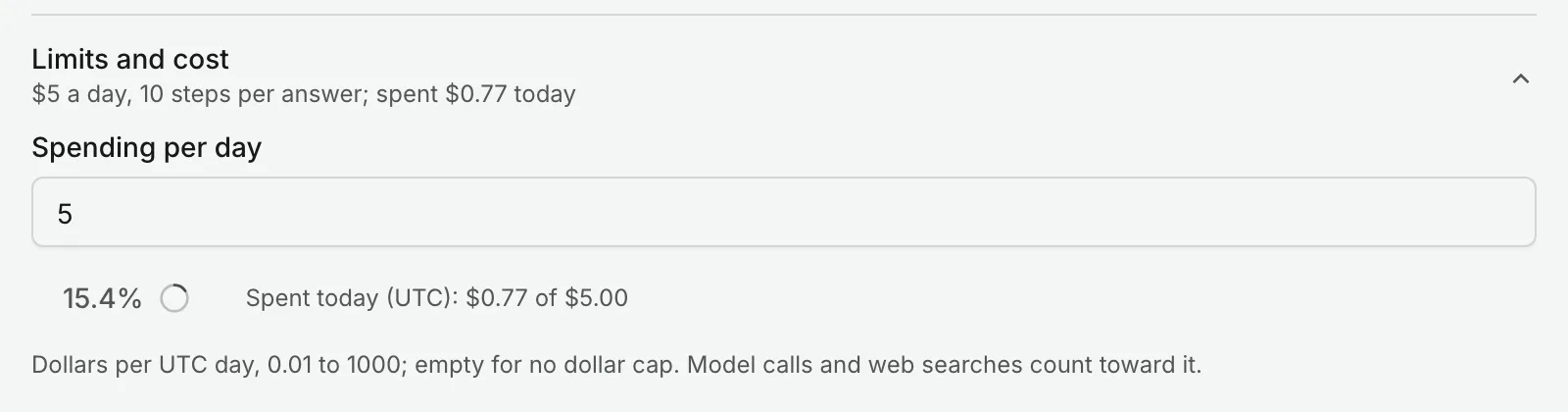
Each agent has a daily dollar cap, and a long run has its own step limit and cost cap on top.
Nothing an organization uploads is public.
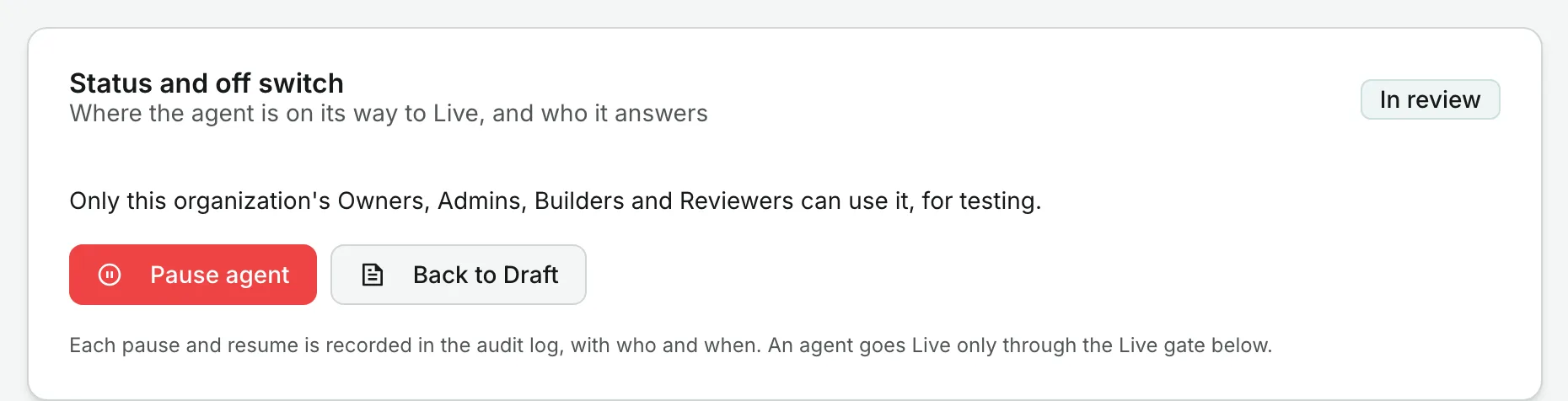
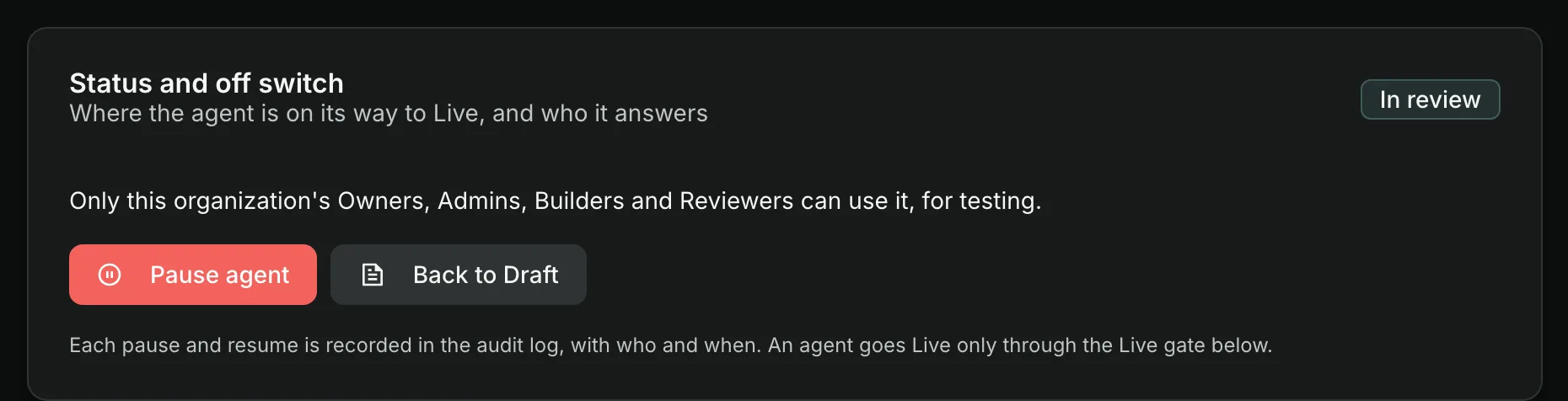
And an agent can't go Live until its off switch has been used at least once, because a switch nobody has pulled is a switch nobody knows works.
How an agent goes Live
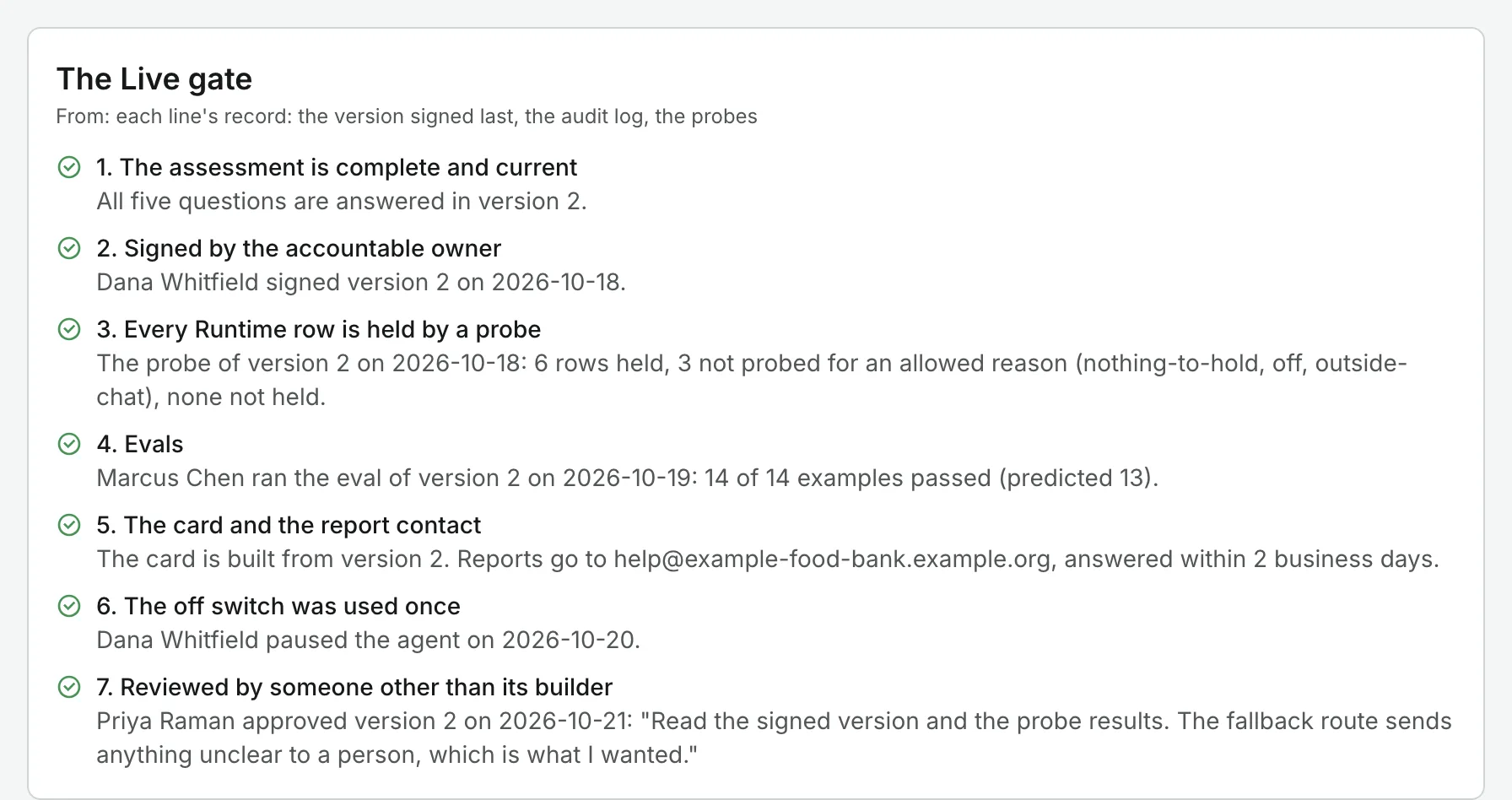
The person who builds an agent is the last one who'll notice what it gets wrong. So the platform doesn't take the builder's word for it. It asks for seven things:
An assessment of what the agent does, who it serves and what could go wrong, complete and current.
A named person who signs the version that will run, and answers for it.
A probe for every rule the platform can enforce. A probe sends the forbidden request and records the refusal. No refusal, no tick.
For the types that can be graded, an eval: examples with answers a person wrote, and the pass rate predicted before the run, recorded beside the one it got.
A card in plain words saying what the agent is and who to contact, and a way for anyone using it to report a problem.
The off switch, used once.
A review by someone other than its builder, required before the agent serves anyone outside the organization or when a risk is rated High. An internal, low-risk agent may go Live without one, and its card says "unreviewed" until it gets one.
The reviewer is one of the organization's own people, an Owner, Admin or Reviewer, reading a page in the app. Actualize staff can review for a team that has no second reader yet.
What the gate can't do is make an agent safe for work nobody tested it on. The probes hold the rules the team wrote down. The eval grades the examples the team gave it. Both are only as good as the afternoon spent on them, which is why the learning here is doing exactly that, together, and not a course.
What's left afterward
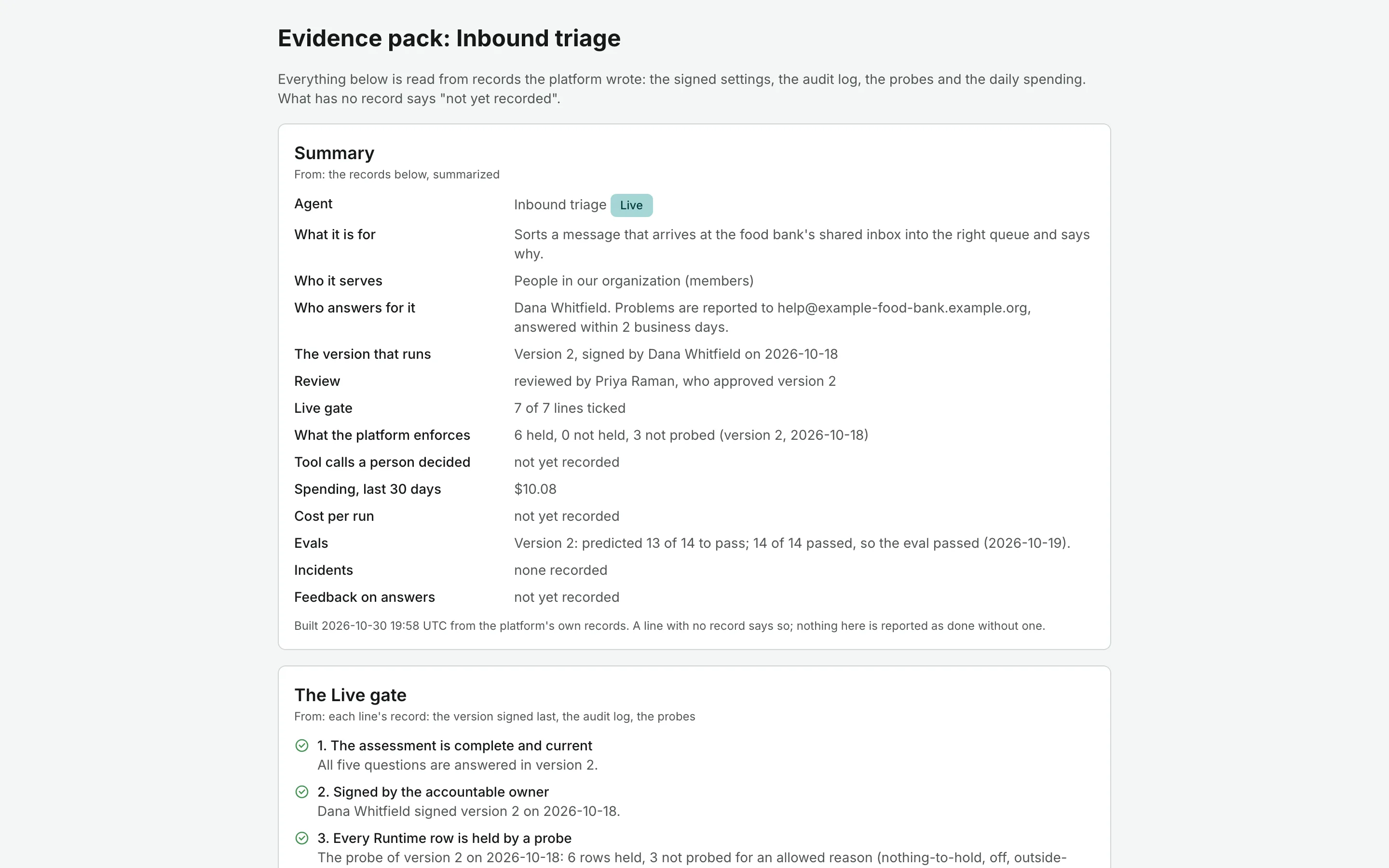
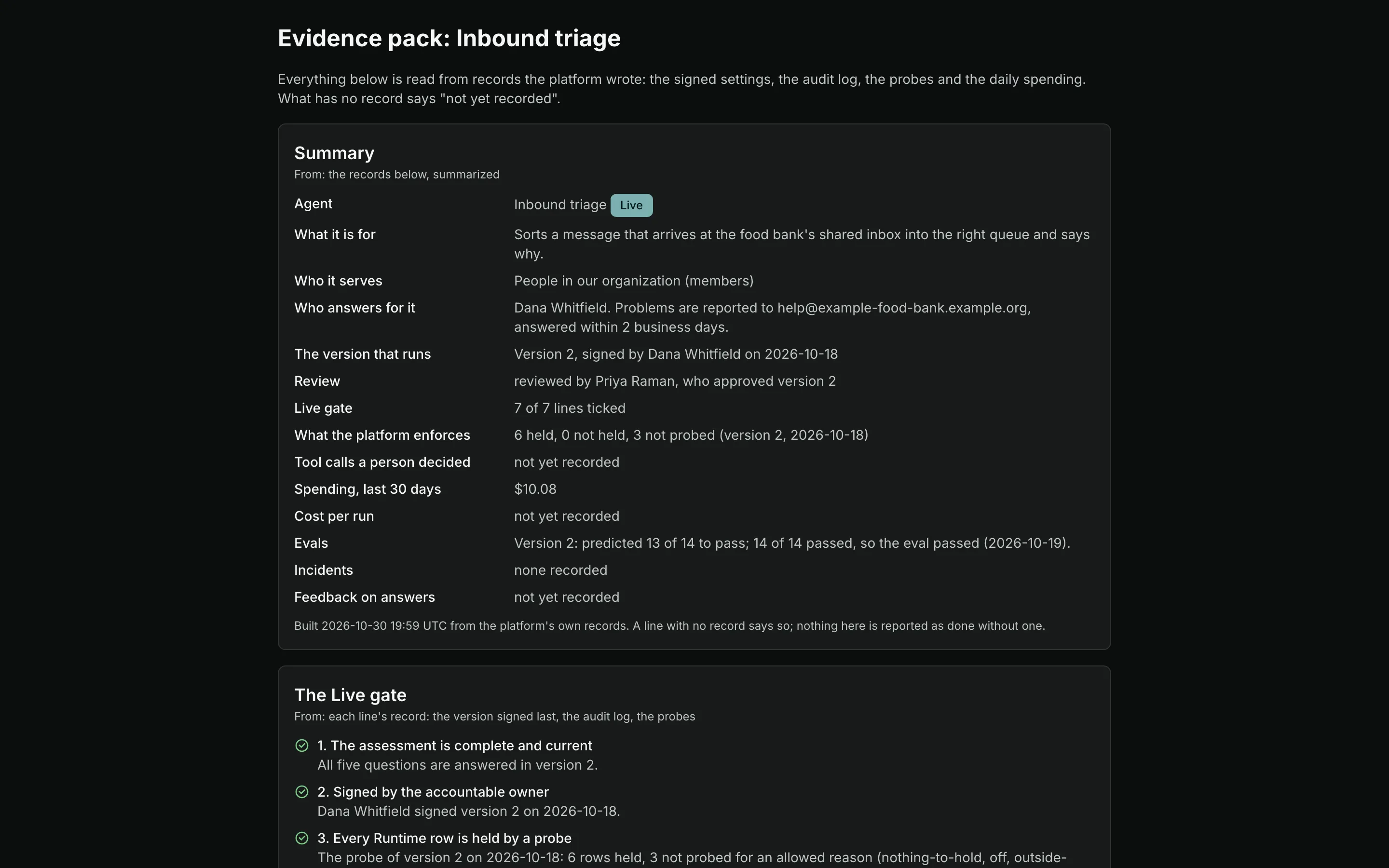
Every change to an agent is written to a log the database refuses to alter. Each agent has an evidence pack: the signed version, every probe result, every eval with its prediction, every incident and how it closed, every review. The organization's Owners, Admins, Builders and Reviewers can read it. A board member can be handed it.
A funder who sponsors a group of organizations will be able to read the evidence packs of that program's agents, never their conversations or data. That part is designed and not built. Today an evidence pack is readable only by the organization that owns the agent.
What it costs to find out
Ask. Organizations are set up by Actualize Impact or by a funder sponsoring them; there's no self-serve sign-up, because the first thing a workspace needs is a person who'll answer for what's built in it, and a form can't check that. Tell us about your organization and the work you'd put an agent on, and we'll come back with what a workspace costs and whether yours is ready.
Contact Actualize Impact